GrauZone
ZoneGrau
A question of theft and property
Lenny Bittger,
Clara Bröning,
Kristina
Goettgens
& Edda Alma Seibert
About
Theft is omnipresent. On a large and small scale, people steal and rob every day. From bank robberies, mask deals, and tax evasion to international wildlife smuggling, the list of thefts is long.
But you don't have to be a criminal to steal something. Not scanning something at the self-checkout, pocketing a mug at the Christmas market, crawling under the turnstile at Sanifair, or gaining access online to things you would actually have to pay for. All of this is theft (from a legal perspective).
In order to steal, someone else must own something, but how does a person acquire this property in the first place, and is it fair? The concept of theft is at least as old as the concept of ownership—they go hand in hand. To rise above theft is to forget its origins. If God exists, why didn't he leave me a condominium (Beslik - Guten Morgen Deutschland).
Where is the moral line? Are some forms of theft more serious than others? The theft shown here is mostly in a legal and moral gray area. As a kind of encyclopedia of stolen things (from A for “accordion” to Z for “quote”), supplemented by essays, this book takes a critical and humorous look at theft and shows the absurdity of certain forms of property.
Design Rules
- The color gray runs through the book as a central color and meaning concept; not only visually in the text, images, cover, and paper, but also in terms of content, reflecting the gray area of theft and ownership.
- The object is small in format, made of lightweight material, and deliberately “easy to pick up”—but its content and high page count make it substantial and eye-catching.
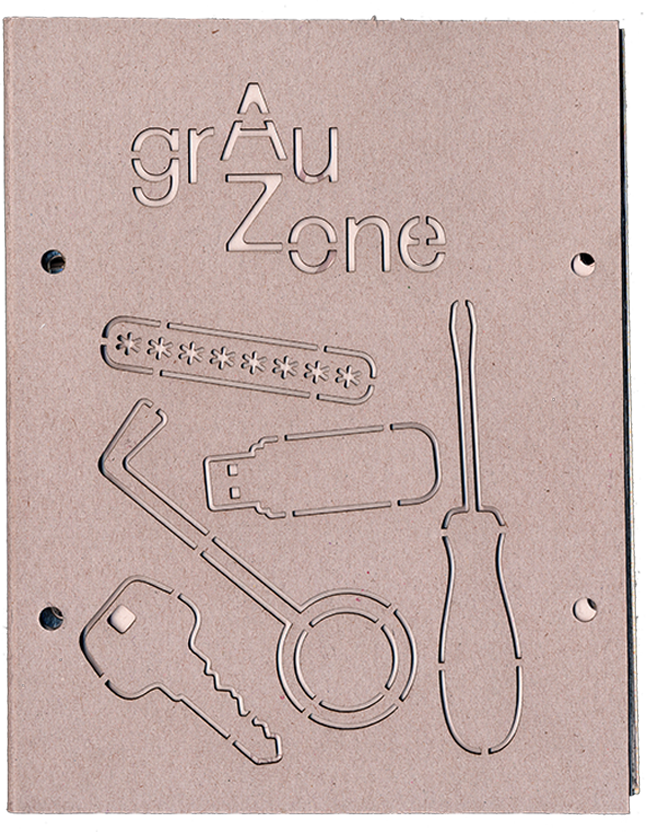
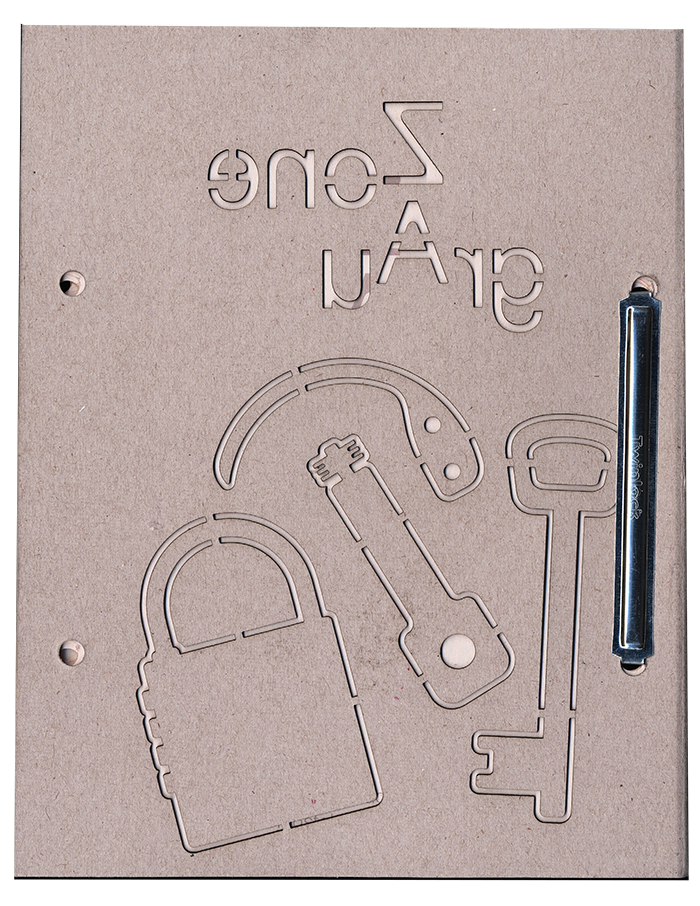
- Two equivalent books are combined in one object by Japanese binding: the front cover is the text volume, the back cover is the picture volume. Turning the book reverses the reading direction (Z–A), which is why contents such as the half-title, imprint, and glossary are duplicated (for double reading direction). Access is via closed staples – opening and entering the book becomes the reader's first action.
- Typographically, we work with “stolen” and fragmented fonts (Makiwara, Mono, NewEdge666 Rounded) that reveal gaps in the text and automatisms.
- The images are created using algorithmic image processing in Python and ChatGPT prompts, supplemented by Riso-printed guilloche patterns inspired by banknotes and anti-counterfeiting measures. Each edition is therefore unique and moves between control and chance—a deliberate gray area.
Technical implementation
Technically, we worked on the illustrated book using Python scripts created with the help of ChatGPT.
Based on our outgoing CVS table, in which we collected terms related to the topic, images were scraped (downloaded) from the Bing search engine, edited and collaged using another script (all based on prompts—i.e., without our direct visual control), and then converted into the final PDF in book format.
The scripts were executed in the Mac command line terminal, which was written down in a txt file and later found its way into the book in a visualization.
The text volume is based on the same table, from which the pages were created using JavaScript and pagedJS via web-to-print. Word breaks and articles were automatically extracted from Wiktionary. The references manually defined in the table form the basis for the glossary, which uses D3js for visualization.